
How to Thaw & Warm Frozen Breast Milk

Rebecca Harrison
Content Writer
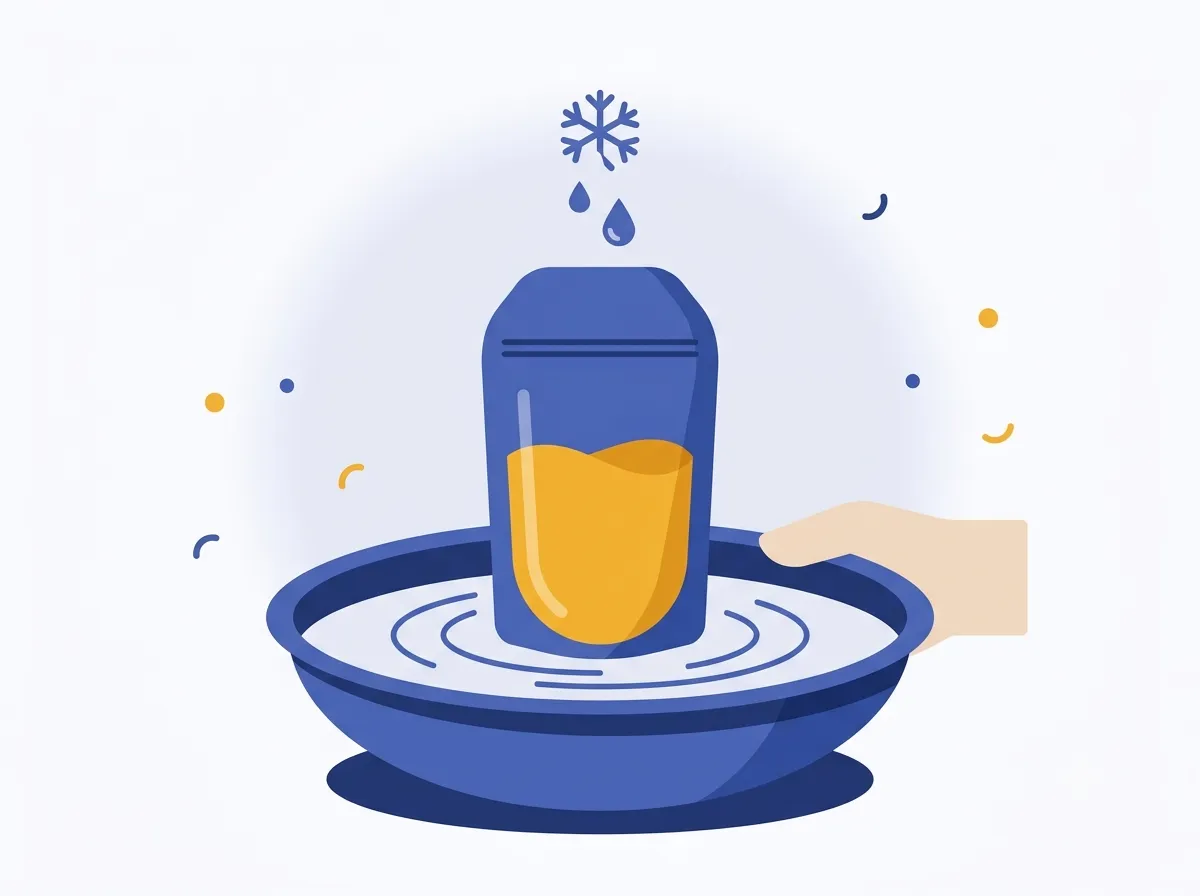
Frozen breast milk is best thawed overnight in the refrigerator. And once it’s thawed, here’s the part nobody tells you: it doesn’t have to be warmed at all. The CDC says plainly that breast milk can be served room temperature or cold, and plenty of babies take it that way without noticing.
What does need getting right is a short list: thaw the oldest bag, keep the milk sealed and nowhere near the microwave, swirl instead of shake, and start the clock the moment the milk finishes thawing rather than when you pulled it out. Here’s the whole procedure, freezer bag to bottle.
Start with the oldest bag
Before you thaw anything, check the date. The CDC’s guidance is to always thaw the oldest milk first, which is the entire reason you wrote a pump date on every bag in the first place.
It’s a small habit with a large payoff, because a bag that keeps getting passed over doesn’t spoil dramatically, it just quietly ages out at the back of the freezer. If your stash isn’t sorted yet, organizing your freezer stash first in, first out makes “grab the oldest one” a two-second decision instead of an archaeology dig.
The three ways to thaw frozen breast milk
All three are safe. They differ in how long they take and how much planning they ask of you.
In the fridge, overnight
Move tomorrow's bag from the freezer to the refrigerator before bed and it will be thawed by morning, usually in several hours. This is the gentlest method and the one that buys you the most time afterward, since fridge-thawed milk keeps for a full 24 hours.
In a bowl of warm water
Stand the sealed bag or bottle in a bowl of warm, not hot, water. Swap the water out as it cools. A small bag is usually ready in about twenty minutes. Keep the water line below the bag's seal so nothing seeps in.
Under running water
Hold the sealed container under cool running water, then gradually warm the water up. This is the fastest option, a few minutes for a small bag and up to twenty for a larger one, and the one to reach for when the bottle was needed five minutes ago.
There’s a fourth method you’ll see suggested in forums that isn’t on this list: leaving a bag on the counter to come up to temperature on its own. It isn’t among the methods health authorities recommend, because the milk spends a long stretch sitting in the temperature range where bacteria multiply fastest. A bowl of warm water is barely slower and doesn’t ask you to guess.
How to warm thawed breast milk
- Decide whether you need to. Thawed milk can be served cold or at room temperature. If your baby drinks it that way, you’re done, and you’ve saved yourself a step at 3 a.m. forever.
- Warm it in water, never in the appliance. Set the sealed container in a bowl of warm water, or hold it under warm running water for a few minutes. The water should be warm to the touch, not hot, and never boiling.
- Swirl the container gently. Warming heats the milk unevenly, and the fat will have separated in the freezer regardless. A slow swirl fixes both.
- Test it on the inside of your wrist. A few drops should feel lukewarm, close to body temperature. If it feels hot to you, it’s too hot for your baby. Let it cool rather than adding cold milk to it.
Bottle warmers are fine as long as they don’t run the milk hot, but don’t leave milk sitting in one to hold temperature. And never heat breast milk directly on the stove.
Never microwave breast milk
The rule is unambiguous: never thaw or heat breast milk in a microwave. There are two separate reasons, and each is sufficient on its own.
The first is burns. Microwaves heat liquid unevenly, so a bottle that feels merely warm on the outside can be hiding pockets of scalding milk that go straight into your baby’s mouth. Swirling afterward reduces the odds but doesn’t remove them, because the hot spots formed before you ever picked the bottle up.
The second is that the heat costs you some of what makes the milk worth freezing. Excessive heat degrades the immune components and living cells that set breast milk apart from formula. Warm water gets the bottle to the same temperature without paying that price, and only takes a few minutes.
Feature Spotlight
Know which bag to thaw next
PumpStash logs every bag with its pump date and keeps the stash sorted oldest-first, so 'thaw the oldest one' stops being a question you answer with a flashlight at the back of the freezer.
See how PumpStash tracks your stash
Swirl, don’t shake
Frozen and refrigerated milk separates, with a layer of cream floating on thinner milk below. That’s normal, and it’s not a sign the milk has turned.
A gentle swirl recombines the fat back through the milk. Hard shaking gets there too, but it whips air in, leaves you with a foamy bottle that’s hard to measure, and doesn’t work any better. Swirl it, check the color is even, and pour.
If thawed milk smells soapy or metallic rather than sour, that’s usually lipase, an enzyme that breaks down fat, and the milk is still safe. The full explanation lives in how long breast milk lasts, alongside how to spot milk that has genuinely gone off.
How long you have once it’s thawed
Thawing restarts the clock. The short version:
- In the fridge: 24 hours, counted from when the milk finished thawing, not from when you took it out of the freezer.
- At room temperature: 1 to 2 hours.
- Once a feeding has started: 2 hours, then discard what’s left. Your baby’s mouth introduced bacteria to the bottle, and this rule overrides the others.
- Refreezing: never. Thaw only what a feed needs.
Those are the practical limits, and they’re the reason to thaw one bag rather than three. For the full storage picture, fresh milk included, see how long breast milk lasts in the fridge, freezer, and thawed.
Thawing mistakes to avoid
- Microwaving it, for hot spots and lost immune properties both.
- Using hot or boiling water, which does a milder version of the same damage. Warm is warm.
- Thawing on the counter, which parks the milk at bacteria-friendly temperatures for hours.
- Refreezing a thawed bag, even if it never left the fridge.
- Counting the 24 hours from the freezer, rather than from the moment the last ice crystal disappeared. It’s the difference between milk that’s fine and milk that’s a day past.
- Letting water into the bag while it sits in the bowl. Keep the seal above the waterline.
Get your number
How many days of cover do you have?
Enter your freezer total and your baby's daily intake, and the breast milk stash calculator tells you how many days of feeds you're holding and when it runs out.
Open the stash calculator
From freezer bag to bottle
Thawing milk well is four decisions: oldest bag first, fridge overnight when you can plan and warm water when you can’t, no microwave ever, and a swirl before it’s poured. Everything else is just remembering when the clock started.
That last part is where an app earns its place. If you’re still filling the freezer, building a breast milk stash covers the pumping side, and what a milk stash actually is covers why any of it matters.
Get PumpStash for Android and let it remember which bag is next.
Frequently Asked Questions
How do you thaw frozen breast milk?
How long does it take to thaw frozen breast milk?
Can you microwave breast milk?
Do you have to warm breast milk before feeding?
Can you thaw breast milk on the counter?
Why do you swirl breast milk instead of shaking it?
About the author

Rebecca Harrison
Content Writer
Mother of three who has pumped, frozen, and rotated her share of milk through the back of the freezer.
Related Articles

Know Your Stash
Skip the freezer guesswork. Log every bag, see how many days of feeds your stash holds, and always thaw the oldest milk first.
Install Now