
How to Build a Breast Milk Stash (Without Wasting Any)

Rebecca Harrison
Content Writer
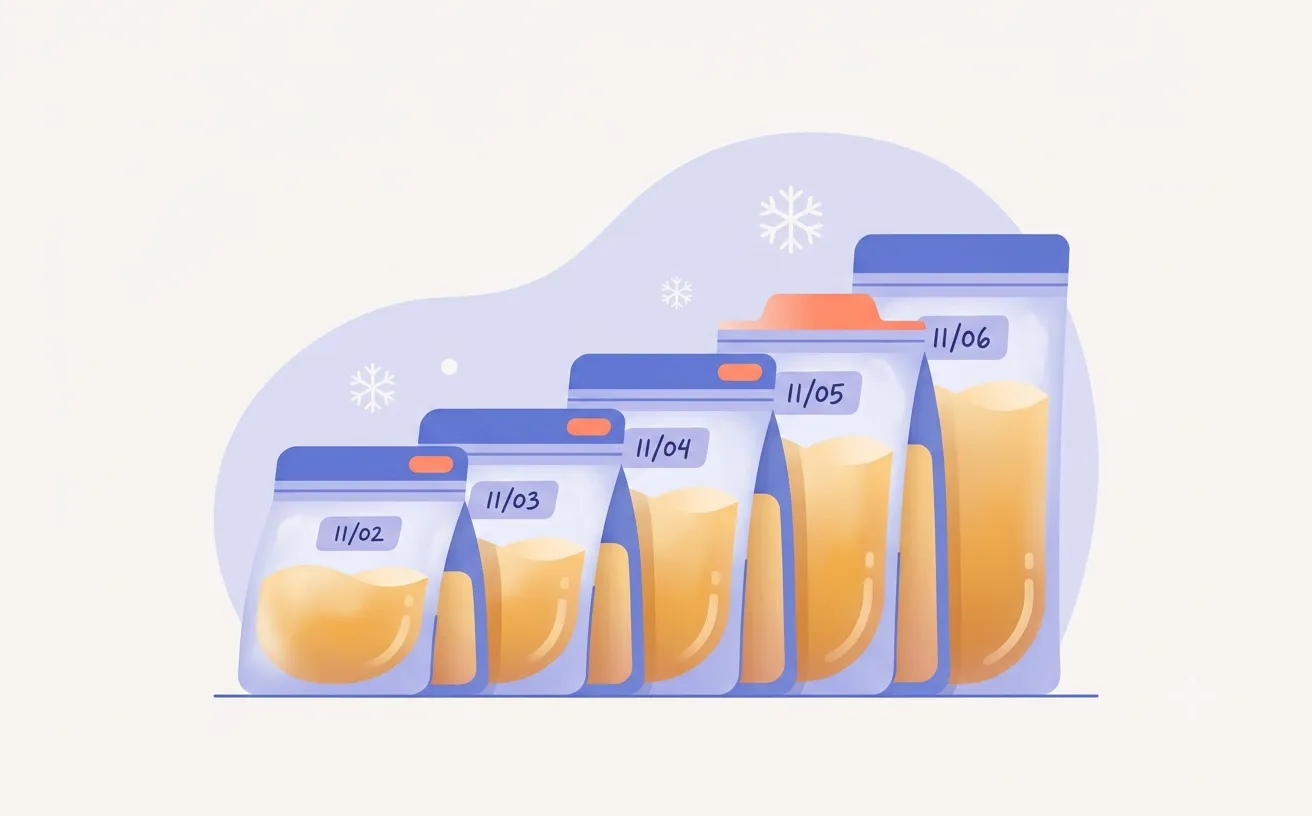
A breast milk stash is the reserve of frozen milk you build up so someone else can feed your baby when you’re not there, on a workday, an evening out, or a morning you’d rather sleep. The part nobody tells you is how much you actually need, and the honest answer is far less than the chest-freezer photos on Instagram suggest.
A right-sized stash covers the feeds you’ll miss plus a small buffer, and you build it by banking a little surplus at a time. Pile up more than that and you’re not building security, you’re freezing milk you’ll throw out at the 12-month mark. Here’s how to build a stash that’s the right size, at the right time, without wrecking your supply to get there.
How much milk should be in a stash?
Start from what your baby eats, not from a target number you read somewhere. Most exclusively milk-fed babies between 1 and 6 months take roughly 24–30 oz a day, spread across 8–12 feeds of 2–4 oz each. That daily figure is the unit your whole stash is measured in. If your goal is to wean from the pump before your baby weans from milk, the size you need depends on how many days you’re covering — work out the date you could stop pumping and the target size falls out of it.
If you’re building a stash to return to work, the math is simple: you need enough to cover the feeds your baby takes while you’re gone. One full day away is usually three to four feeds, or about 12–15 oz, and that’s what you need on day one. From day two you refill it with what you pumped the day before. A few days’ cushion on top, 30–40 oz, covers a slow session or a spilled bottle. See the return-to-work plan for the full calculation.
The reason a smaller stash works is that you keep replacing it. Each day at work you pump roughly what your baby eats that day, and tomorrow’s bottles come from today’s pumping. The frozen stash is a backup for the gaps, sick days, a slow pumping session, a missed break, not the daily supply itself.
Get your number
How many days does your stash cover?
Enter your current freezer total and your baby's daily intake, and the breast milk stash calculator tells you how many days of feeds you have and when it runs out. Build toward a real number instead of guessing.
Open the stash calculator
When should you start building a stash?
Wait until your supply is established, usually around 4 to 6 weeks postpartum. In the early weeks your body is still calibrating how much milk to make, and your newborn is the one setting that demand. Pumping hard for a freezer stash before then can push your supply higher than your baby needs and leave you dealing with engorgement, clogged ducts, and oversupply.
If you’re heading back to work, a good rule is to start building three to four weeks before your return date. That’s enough runway to bank a week’s cushion without marathon pumping, and it means the milk in your freezer is fresh rather than approaching its use-by window before your baby ever drinks it.
Earlier is not better here. A stash you start at week one is a stash where the oldest bags are pushing 6 to 12 months old right when your baby would be drinking them, and every bag you freeze beyond what you’ll realistically use is milk headed for the drain. Build for the cushion you need, then stop adding and simply maintain.
How to pump for a stash without hurting your supply
The fear that stashing will tank your supply is reasonable, and it usually comes from doing it the hard way. The goal is to add a little extra milk on top of what your baby takes, not to compete with your baby for it. A few habits do most of the work:
- Pump after morning feeds. Supply is highest in the morning, so a 10–15 minute session after the first feed of the day often yields the most for the least effort. Even an ounce or two a day adds up over a few weeks.
- Add one session, don’t replace one. Squeeze in an extra pump between feeds rather than skipping a feed to pump, which only signals your body to make less.
- Try power pumping once a day. Twenty minutes of pump-rest-pump intervals (10 on, 10 off, 10 on) mimics cluster feeding and can nudge supply up over about a week.
- Catch the other side. If your baby feeds on one breast, pump or use a silicone collector on the other to catch the letdown you’d otherwise lose.
Small and consistent beats long and occasional. Two short sessions a day for three weeks will build a healthier stash than one exhausting hour that leaves you sore and your baby short the next morning. If you ever feel your supply dipping or your baby seeming hungry, pull back, the stash can wait, a fed baby and a sustainable supply can’t.
Building a stash while exclusively pumping
If you’re exclusively pumping, the math flips: you’re already pumping for every feed, so your stash is the surplus over what your baby drinks that day rather than the product of extra sessions. How quickly that surplus accumulates depends entirely on your pumping schedule, which is its own subject, covered in your exclusive pumping schedule.
Store it so none goes to waste
A stash is only as good as your ability to use the oldest milk before it expires, and that’s where freezer organization quietly makes or breaks the whole effort. The fundamentals, drawn from CDC storage guidance:
- Freeze in 2–4 oz portions so you thaw only what a feeding needs and waste less.
- Lay bags flat to freeze, then stack them like files once solid, oldest at the front.
- Date every single bag with the day you pumped, and always pull the oldest first (first in, first out).
- Aim to use frozen milk within 6 months, though it stays safe up to 12.
For the full breakdown of how long milk keeps at every stage, and how to tell when a bag has actually gone bad, see how long breast milk lasts in the fridge, freezer, and thawed.
Feature Spotlight
Never lose a bag to the back of the freezer
PumpStash logs every bag with its pump date, keeps your stash sorted oldest-first, and tells you exactly what to thaw next, so the milk you worked for actually gets used before its window closes.
See how PumpStash tracks your stash
A realistic four-week starter plan
If you’re working toward a return date, here’s how a calm month of building looks:
- Week 1: Add one short pumping session a day, right after your baby’s morning feed. Freeze whatever you get, even if it’s just an ounce. You’re building the habit as much as the stash.
- Week 2: Keep the morning session and add a second short one between afternoon feeds if your supply feels steady. Start dating and laying bags flat from day one.
- Week 3: Hold the routine and watch your total climb. Use the calculator to check how many days of cover you have so far, and adjust your goal if you’re ahead or behind.
- Week 4: Do a practice run, have your partner or caregiver give a bottle from the stash while you pump at the same time. It confirms your baby takes a bottle, tests your back-to-work rhythm, and rotates your oldest milk.
By the end of the month most parents have a comfortable cushion and a routine they can keep going on workdays, which is the part that actually sustains a stash long-term.
Build it once, then let it run itself
Building a stash is mostly patience, a little extra milk each day, stored in order, used before it expires. The hard part isn’t the pumping, it’s keeping track of dozens of dated bags and knowing, at a glance, whether you have enough.
Want a quick estimate first? The breast milk stash calculator shows how many days of feeds your current stash covers. PumpStash then keeps it live: log each bag as you freeze it, watch your days of cover update as your baby grows, and always know which milk to thaw next.
Get PumpStash for Android and let your stash keep its own count.
Frequently Asked Questions
How many bags of breast milk should I have stored?
When should I start building a breast milk stash?
Will pumping for a stash hurt my milk supply?
Is it too late to start a stash?
How much should I pump in one session for my stash?
About the author

Rebecca Harrison
Content Writer
Mother of three who has pumped, frozen, and rotated her share of milk through the back of the freezer.
Related Articles


Know Your Stash
Skip the freezer guesswork. Log every bag, see how many days of feeds your stash holds, and always thaw the oldest milk first.
Install Now